Overview
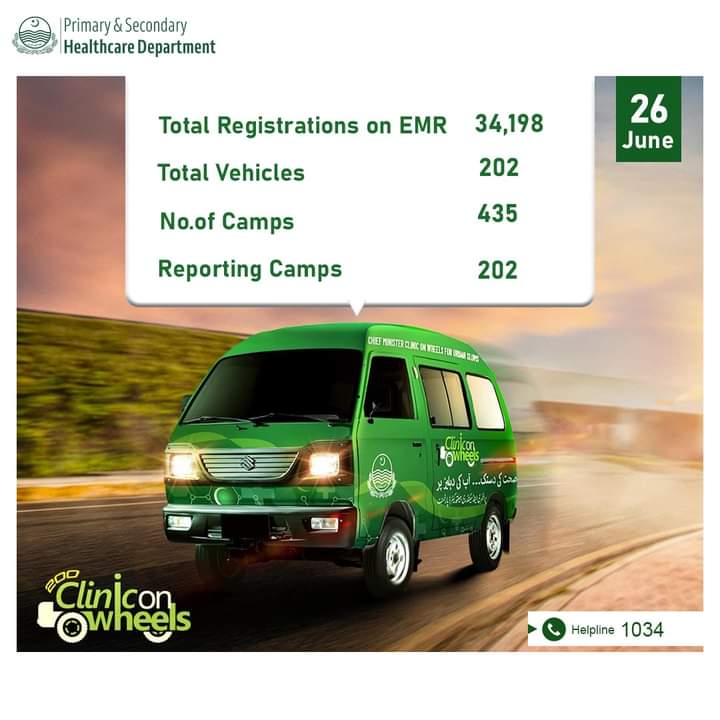
“Clinic on Wheels” is a flagship initiative of the Primary & Secondary Healthcare Department (P&SHD) designed to provide quality healthcare services to underserved urban slum areas across Punjab. Through specially equipped mobile clinics, including passenger and ultrasound vehicles, staffed by trained medical professionals, the program aims to deliver essential preventive and curative care directly to communities lacking access to healthcare facilities. This initiative reflects the Punjab government’s commitment to ensuring equitable, accessible, and inclusive healthcare for all citizens.
Operations & Service Package
Under the Chief Minister’s “Clinic on Wheels” Program, ambulances will operate from 9:00 a.m. to 3:00 p.m., Monday to Saturday, visiting urban slums and peri-urban areas across Punjab. Each district will have 3–10 vehicles, including one ultrasound-equipped unit for every five vehicles. Routes and parking points will be determined based on need, while Lady Health Workers (LHWs) will handle pre-registration, and daily operations will be managed through the Centralized Reporting and Coordination (CRC) system. The mobile clinics will provide treatment for minor ailments, referrals for specialized care, maternal and child health services (ANC, PNC, delivery referrals, family planning), immunization for children under two, nutritional screening for children under five, and diagnostic tests for Hepatitis B & C, malaria, diabetes, and hypertension. Additional services include dengue surveillance and health education sessions promoting preventive care and healthy lifestyles.
Implementation of Initiative
It was inaugurated on May 10, 2024, with services launched on May 13, 2024. Currently, 680 mobile clinics operate across Punjab, including 202 passenger vehicles for transporting medicines and staff to camps and 42 ultrasound-equipped vehicles for diagnostic and maternal health services. This extensive network ensures efficient and consistent delivery of essential healthcare to underserved communities across the province.
Method of Enforcement
Suzuki Bolan vehicles operate in urban slums and peri-urban areas from Monday to Thursday and Saturday (9 a.m.–3 p.m.) and Friday (9 a.m to 1 p.m.). Fleet size ranges from 3–18 vehicles per district, with one ultrasound vehicle for every four passenger units. The Call Response Center (1034) assigns daily tasks, and health teams, comprising a Medical Officer, Lady Health Visitor, Dispenser, and Vaccinator, are deployed with medicines and supplies per the micro plan. Services include minor ailment treatment, referrals, family planning, maternal and child healthcare, immunization, nutrition screening, and diagnostic tests for Hepatitis B & C, hemoglobin, and diabetes, alongside health education and counselling. Vehicle management and operations are outsourced to a third party for effective service delivery.
Way Forward
The initial public response in urban slums is promising, and this model of service may be replicated in areas with poor health and socio-economic indicators, and among underprivileged and marginalized segments of the population.